Noise Cancelling Earplugs for Work: How to Choose a Pair
Match the earplug type to your workplace: filtered silicone for steady background noise, active earbuds for calls and music. Then check fit and comfort across a full shift.
The Folio & Current Team
November 14, 2026 · 9 min read

The right noise cancelling earplugs for work depend on the noise around you and on whether you still need to hear people. For steady background hum in an office, reusable silicone earplugs with an acoustic filter lower the volume across the range. For calls or music, active earbuds fit the job, and a loud floor calls for the equipment your employer specifies.
This guide sorts earplug types by workplace scenario, then covers a fit check, a comfort check for a full shift, care, and the mistakes to avoid.
What noise cancelling means for earplugs
The phrase covers two different technologies, and labels do not always say which one you are getting. Passive noise reduction comes from the build: the tip seals the opening of the ear canal and the body blocks or filters sound. Foam, silicone and filtered plugs all work this way, and none of them needs a battery.
Active noise cancellation uses small microphones and a processor to generate counter-sound, so it needs power and lives inside earbuds. It is aimed at steady, low-pitched sound such as air handling or a distant highway. Our guide to wireless earbuds with active noise cancellation explains what to check on that side.
Both types lower noise intensity rather than remove sound. Plan for that: you can still hear a raised voice, a door or an alarm, which matters in a workplace.
Choosing noise cancelling earplugs for work by scenario
Start with the room, not the product. Ask three things: is the noise steady or sudden, do you need to hear colleagues or alarms, and do you take calls?
| Scenario | Typical noise | Earplug type to consider | Watch for |
|---|---|---|---|
| Quiet private office | Keyboard, hallway chatter | Filtered silicone or soft foam | Fit that stays put when you talk |
| Open-plan office | Overlapping voices, phone calls | Filtered silicone, or active earbuds | Still hearing your name and alerts |
| Hybrid or home desk | Household sounds, street noise | Filtered silicone for focus; earbuds for calls | A case you can keep at the desk |
| Warehouse or workshop floor | Machinery, impacts, alarms | Equipment your employer specifies | Workplace rules come before any consumer earplug |
| Commute to and from work | Engines, announcements | Active earbuds or filtered silicone | Awareness of traffic and announcements |
Office and open plan
Open-plan noise is mostly voices, and voices are hard to ignore. A plug that lowers the volume of everything, speech included, gives you a blurred room instead of a hushed one, which can be enough to read, write or code.
A filter that lowers bass, mids and treble together keeps the room present at a reduced level instead of cutting one range. Check that you can still catch a colleague saying your name, and that you can still hear a fire alarm.
Loud floor
If your work involves machinery, power tools or sustained loud noise, a consumer earplug is not a substitute for the hearing protection your employer provides. Follow your workplace safety rules and ask your safety officer or an occupational hearing professional what is required for your tasks.
Home desk with a headset
If you work from home and wear a headset on calls, check how the pieces share space. Earbuds and headset ear cups can press on each other, and a plug stem that rests against the outer ear needs room next to the cup. Try the combination during a real call before you rely on it.
Also check that you can hear the doorbell, a timer or a family member calling you, since the plug lowers those sounds too.
Foam, silicone, filtered or active: how they compare
Four families cover the earplugs sold for work. Each has a different tradeoff in fit, upkeep and how much of the room you keep.
| Type | How it works | Reusable | Good for | Tradeoff |
|---|---|---|---|---|
| Soft foam | Expands inside the ear canal opening | Often disposable | Short, noisy tasks | Needs rolling and inserting each time |
| Solid silicone | Molded body and tips seal the ear | Yes, washable | Long focus blocks | Muffles speech along with everything else |
| Filtered silicone | Acoustic filter lowers the volume of surrounding sound | Yes, washable | Offices, shared spaces, commutes | Check that you can still hear what you need |
| Active earbuds | Microphones and a processor add counter-sound | Yes, but needs charging | Calls, music, steady drone | Battery, pairing and a larger body in the ear |
For an office, the choice often comes down to filtered silicone versus active earbuds. If you want music or calls, take a look at the Headphones & Earbuds collection. If you only want the room turned down, a reusable plug with no battery or pairing is an object you can keep in a drawer.
Wired, wireless or no electronics
Wired earbuds suit calls at a desk, while wireless ones free up your hands for walking to meetings. If you take video calls, a headset with a boom is another route, covered in our guide to noise cancelling headphones with mic. For focus without any electronics, a passive plug has no pairing, charging or software to manage.
Reading the decibel number
A decibel figure on a package is a lab value measured under set conditions. Your ear shape, the tip size and the seal decide what you actually get at your desk, so read the number as a loose guide and check fit first.
A filtered silicone option for the desk
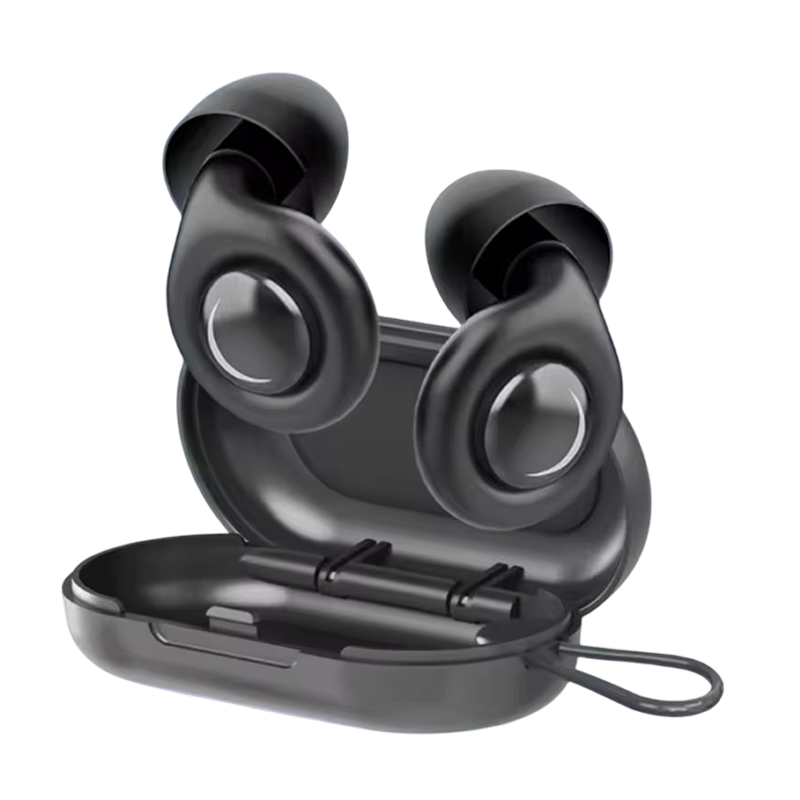
AcuVeil is a pair of reusable ear plugs with an acoustic filter. The filter lowers volume across bass, mids and treble together instead of cutting one range. It is made for concerts and other loud events, and it is also used on flights and daily commutes, so it can double as a commute pair for the trip to work.
The box holds four pairs of silicone ear tips in XS, S, M and L, so you can pick the size that seats in your ear canal. The stem rests against the outer ear, and a compact carry and storage case is included for keeping the plugs between uses.
 In this guideAcuVeil$79.99View
One limit to keep in mind: AcuVeil is made for listening at concerts and amplified events, and it lowers volume rather than removing sound. For a loud floor, use the hearing protection your employer specifies.
Check the fit before you commit
A plug in the wrong size lets sound leak around it, which is a frequent reason an earplug seems to do nothing. Check fit before any feature on the box.
- Wash your hands and start with the medium ear tip, or whichever size your first guess suggests.
- Attach the tip to the earplug body as the manual describes.
- Place the earplug in your ear so it sits snug, with the stem resting against the outer ear.
- Play a steady sound, like a fan or a podcast on a speaker, and press lightly on the outer body, without pushing it deeper into the ear canal. A large change in the sound suggests the seal is loose.
- Try the next size up or down on the same ear. Ear shapes differ, and the left and right ear can need different sizes.
- Keep the size that seals without you having to hold it in place.
Then run the talk test: speak, chew and turn your head. A plug that loosens when your jaw moves does not hold through a day of calls and lunch.

Comfort over a full shift
A pair can seem fine for ten minutes and become tiresome by mid-afternoon. Judge it over a real work block instead of a trial in the hallway.
A one-week trial plan
- Days 1-2: wear them for one focus block, such as a single long task, and take them out at the end.
- Days 3-4: wear them for a half day and note whether you adjust them more than once an hour.
- Day 5: wear them through a full shift including a call, a meeting and a break.
Take them out between blocks and give your ears a rest, and drop any pair that you keep needing to readjust. If you notice anything unusual with your ears, remove the plugs and ask a hearing professional.
What to check as the day goes on
- Whether the plug has worked loose after talking or chewing.
- Whether the stem presses against your headset, glasses arms or a hood.
- Whether you can still hear the sounds you must catch, such as a phone alert, a door or an alarm.
- Whether you can rest your head on a headrest without the plug shifting.
Build matters too. A passive plug and an earbud with a battery are made differently, so test each type for the same length of time.
Headrests and reclined seats
If your chair has a headrest, or you lean back during breaks, the plug body can shift against the cushion. Lean back with the plugs in and see whether the stem moves. A low-profile body and a snug tip size matter more here than any feature on the box.
The same check applies to a nap room or a quiet corner: lie or recline for a few minutes before you rely on the pair for a longer stretch. Keep in mind that the plug also lowers an alarm or a colleague calling your name.
Noise sensitivity at work
Some people find constant background sound hard to work through. If that describes you, a filter that lowers all frequencies together gives a more even room than a plug that cuts one range. Start with short wear blocks, keep a pair of tip sizes at hand, and change your routine based on what fits your day. A qualified professional can advise on individual needs.
Care, cleaning and storage
Reusable plugs sit in your ears every day, so they need a routine. For the filtered silicone pair above, the product page says to rinse the plugs with warm water, let them air dry, then put them in the included case until the next use.
- Rinse after each day of use, following the manual.
- Dry completely before they go back in the case.
- Do not share earplugs between people.
- Keep the case in a bag or desk drawer so the tips stay free of lint.
- Inspect the tips for cracks or deformation, and swap in a spare pair of tips from the box when you want a fresh set.
Our guide on how to clean earbuds covers general case care. Follow the manual that comes with your pair first.
Field note
Keep the case in the same place every day, at your desk or in your bag. A pair that lives loose in a pocket collects lint, and a pair left on a desk gets lost.
Common mistakes when choosing earplugs for work
- Buying on a decibel number alone. The figure on the box says little about how the plug fits your ear, so check fit first.
- Expecting total quiet. Earplugs lower the volume rather than remove sound, so check that you can still hear the alarms you need to.
- Skipping the sizing step. Try every tip in the box before you decide.
- Using a consumer plug where your employer requires specified equipment.
- Wearing a pair for hours without a break to check the fit.
- Skipping cleaning. Reusable plugs still need rinsing.
A short decision checklist
- Name the noise: voices, machinery, traffic or a mix.
- Decide what you must still hear: colleagues, alarms, phones.
- Pick passive for a battery-free setup, or active if you want music or calls through the same device.
- Confirm your workplace rules allow earplugs where you work.
- Run the fit test with every tip size.
- Do the one-week trial.
- Set a cleaning routine and keep the case where you will see it.