Universal Travel Adapter for Thailand: Plug Types and Voltage
A universal travel adapter for Thailand changes the plug shape, not the voltage. Check your device label for 100-240V, then pack the adapter that matches Thai outlets.
The Folio & Current Team
November 20, 2026 · 5 min read
A universal travel adapter for Thailand only needs to solve one problem: fitting your plug into a Thai wall outlet. Thailand supplies 220V at 50 Hz, while US outlets supply 120V, so the adapter does not change the voltage your device receives. Check each device label for 100-240V before you pack, and bring a separate voltage converter only for devices that lack that range.
Which plug types Thailand uses
Thai outlets are commonly Type A, B, C, F and O. Type O is the Thai-specific standard, with three round pins. In practice, many sockets are multi-standard outlets that take both flat two-pin plugs and round two-pin plugs, which is why a US phone charger often fits without anything extra.
That does not mean every outlet is the same. Older hotel sockets, guesthouse wall plates and extension strips vary, so carry an adapter rather than relying on luck.
Plug types at a glance
| Plug type | Shape | Where you see it | Fit in Thailand |
|---|---|---|---|
| Type A | Two flat parallel pins | US, Canada, Japan | Often fits multi-standard outlets |
| Type B | Two flat pins plus round ground pin | US grounded plugs | May fit; the ground pin can be blocked |
| Type C | Two round pins | Much of Europe | Fits the round-pin openings |
| Type F | Two round pins with side ground clips | Germany, much of Europe | Often fits, ground clips may not engage |
| Type G | Three rectangular pins | UK | Does not fit without an adapter |
| Australian style | Two angled flat pins | Australia, New Zealand | Often does not fit; use an adapter |
| Type O | Three round pins | Thailand | The local standard |
220V vs dual-voltage devices
Voltage is where travelers get into trouble. A plug adapter only reshapes the prongs. A device built for 120V and plugged into 220V can overheat or fail, so read the small print on the charger or power brick.
- If the label says input 100-240V, the device accepts Thai voltage. Phone, tablet, laptop and camera chargers often carry this range, but confirm yours.
- If the label says only 120V, the device needs a voltage converter or should stay at home. Hair dryers, curling irons and some shavers often fall here.
- Check the frequency too. Thailand runs at 50 Hz, and motors or clocks built for 60 Hz can behave differently.
When unsure, follow the device manual or ask an electrician. Heating appliances draw a lot of power, so a small adapter is not the right tool for them.
Choosing a universal travel adapter for Thailand
Look for these features, in order of importance:
- Prong styles that match the plugs you bring, or that fit round and flat Thai openings.
- A wattage and amperage rating printed on the body that covers your charger.
- Built-in USB ports, so a phone and earbud case can charge from one outlet.
- Shutters or an indicator light that show the connection is powered.
- A compact shell, so it fits in a carry-on pocket.
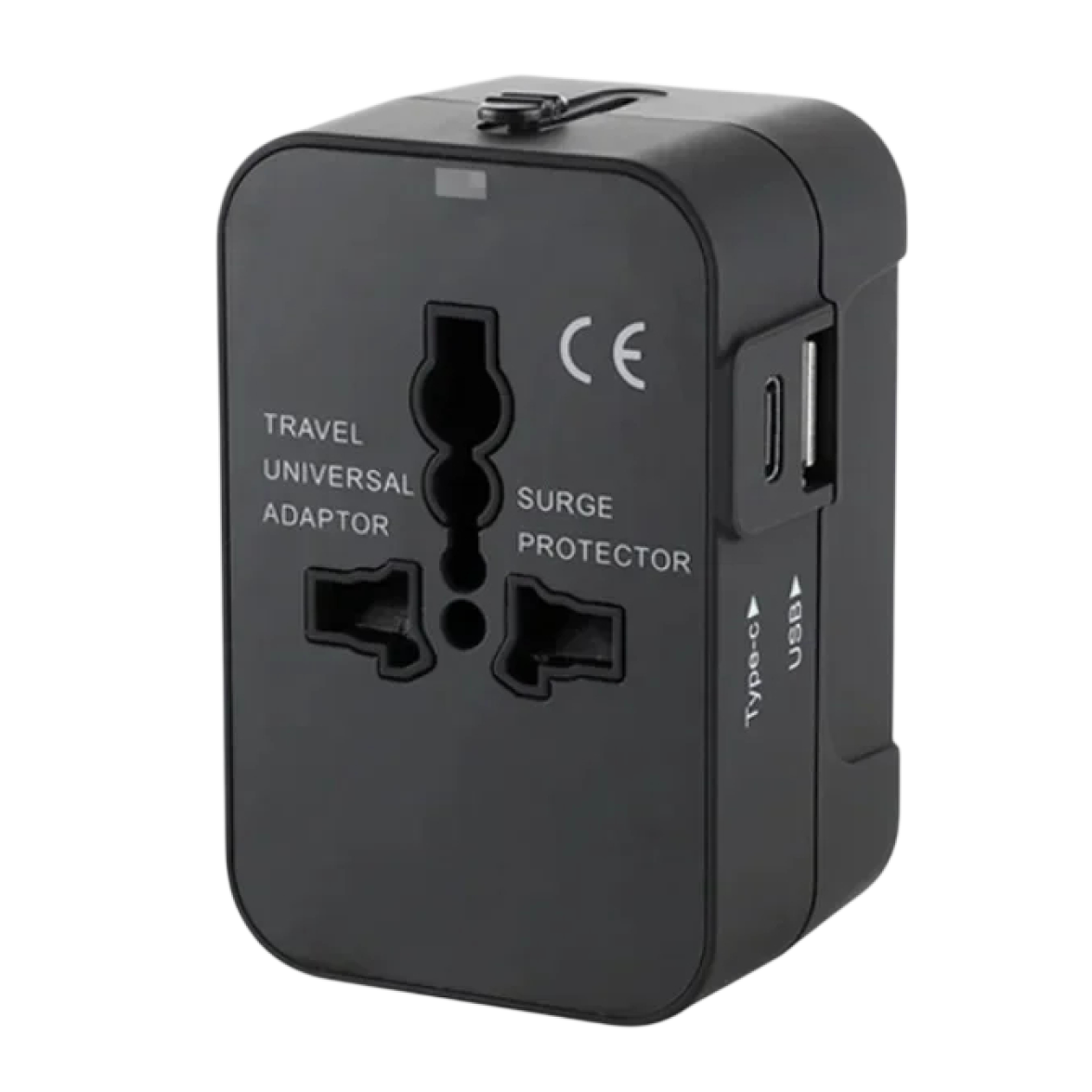
OutletAtlas is a travel plug adapter with slide-out prong configurations for US, UK, EU and AU outlets. It has two built-in USB ports with 5V/2.1A output, plus a socket on the adapter that takes a plug directly. Safety shutters and an LED indicator show a powered connection, and a compact travel pouch is included.
Because Thai outlets vary, read the plug compatibility guide in the box and test the fit at the outlet before you leave a device charging. Check the product page for its input range before plugging in anything beyond USB charging.
 In this guideOutletAtlas$49.99View
Do European, UK and Australian plugs work in Thailand?
European plugs with two round pins generally fit the round openings in Thai outlets, so a Type C charger often works without an adapter. Grounded Type F plugs may fit, but the side clips may not make contact.
UK plugs have three rectangular pins and do not fit, so a UK traveler needs an adapter. Australian plugs have angled flat pins; some Thai outlets accept them, but many do not, so pack an adapter for the trip. Voltage is closer for these travelers: Europe, the UK and Australia all run near 230V, so the plug shape is the main issue.
US travelers have the opposite situation. The plug often fits, but the voltage is higher, which is why the label check matters more than the adapter.
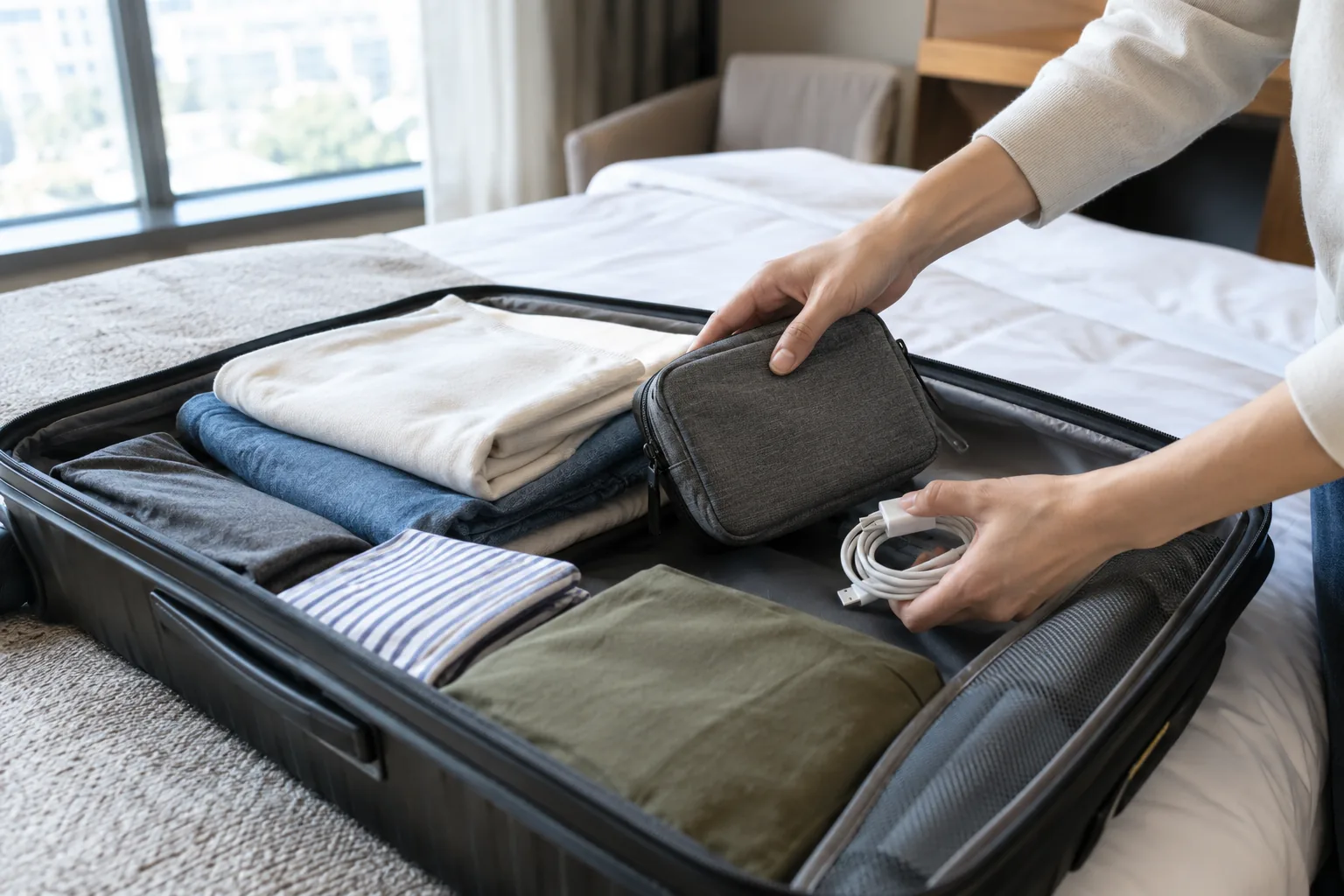
Packing checklist for US travelers
| Item | What to check |
|---|---|
| Plug adapter | Prongs fit Thai outlets; carry one per person charging at once |
| Device chargers | Label reads 100-240V |
| Voltage converter | Only for 120V-only devices |
| USB cables | Match each phone, tablet and earbud case |
| Power strip | Check its label; some are 120V only |
| Pouch | Keeps small parts together in your bag |
Leave 120V-only grooming tools at home and buy a local one if you need it. A US power strip is a common mistake: plugged into 220V through an adapter, it still carries the limits printed on its label. Our guide to surge protectors vs power strips explains how to read those labels.
Field note
Photograph the label of every charger before you leave. Having the input range on your phone lets you check 100-240V at the packing stage.
Common mistakes to avoid
- Assuming an adapter converts voltage. It does not; only a converter or a dual-voltage device handles 220V.
- Forcing a plug that does not fit. If it resists, use the adapter.
- Plugging heating appliances into a small adapter.
- Packing one adapter for a group that charges at the same time.
- Putting the adapter in checked luggage, where a missed bag leaves you without a way to charge.
Unplug the adapter from the wall before you connect or disconnect larger devices, and follow each device's manual.
For more travel power gear, browse Chargers, Docks & Storage. If you are choosing a bag for your electronics, see how to choose a laptop backpack.
Decision steps
- List every device you will bring.
- Read each label for 100-240V.
- Set aside any 120V-only device.
- Pick an adapter with prongs for your plugs and USB ports for small devices.
- Test the fit in your first outlet in Thailand.
Following these five steps covers the setup for phone, tablet and laptop charging.