
Record Players With Built In Speakers: What to Check Before Buying
Record players with built in speakers suit casual listening if the tonearm is adjustable, the platter is isolated and there are outputs for later. This checklist shows what to avoid.
Ryan Kessler
October 16, 2026 · 9 min read
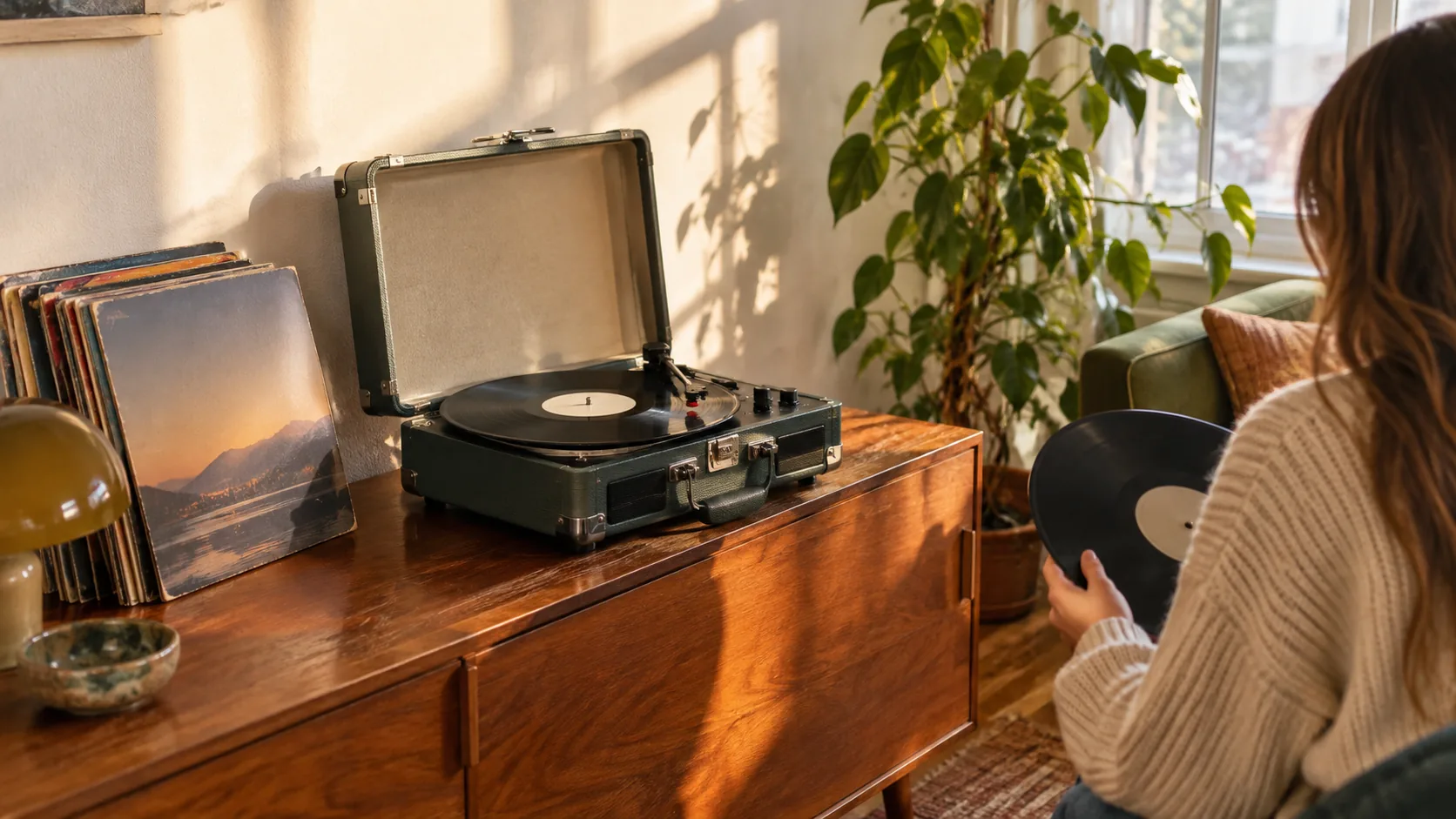
Record players with built in speakers are a fair choice for casual listening in a bedroom, dorm or small living room, as long as you check four things first: an adjustable tonearm and cartridge, a platter isolated from the speakers, the connections on the back, and what Bluetooth actually does. Skip any model without outputs, because outputs are what let you upgrade later.
This guide gives you a checklist of what to avoid, a quick setup routine, a short explanation of phono stages and amplifiers, and a clear point at which external speakers make sense.
The checklist: what to avoid in record players with built in speakers
Spec sheets for all-in-one players read alike. These checks separate a player you can live with from one that frustrates you later.
| Check | Look for | Avoid |
|---|---|---|
| Tonearm | Adjustable cartridge, a lift lever, an arm that moves freely | A fixed, sealed arm with no way to change the cartridge |
| Platter and drive | Belt drive, a platter sitting on a suspended plinth | A platter mounted on the same rigid board as the speakers |
| Speed settings | 33⅓ and 45 RPM at minimum; 78 if you own older records | A single speed when your collection is mixed |
| Outputs | RCA outputs, a headphone jack | Speakers as the only way to listen |
| Bluetooth | A clear description of what it does (receive or send) | Vague wording such as "wireless ready" |
| Auto-stop | Playback ends when a side finishes | An arm that keeps tracing the run-out groove |
| Power and build | Included power adapter, a sturdy lid and handle | Thin plastic hinges and a loose lid |
A tonearm you cannot adjust or replace
The cartridge and stylus touch your records every time you play them. A worn stylus can damage grooves, so you want a setup you can adjust and service. If the listing says nothing about the cartridge, read that as a warning sign.
Also check that the arm has a lift lever or another cueing method. Dropping a stylus by hand onto a record is how scratches happen.
Speakers sharing the platter's board
Sound from speakers creates vibration. When the speakers and the platter share one rigid surface, that vibration can travel back into the stylus and muddy the sound quality, especially at higher volume. Look for a design where the platter sits on a suspended plinth, separate from the speakers. Our VinylHaven is built this way.
No outputs at all
A player with speakers only is a dead end. RCA outputs let you connect an amplifier or external speakers later, and a headphone jack lets you listen without disturbing anyone. Check the manual for the output type, since some outputs expect an amplifier with a phono input and others do not.
Only one speed
Most albums play at 33⅓ RPM and many singles at 45 RPM. Older shellac records need 78 RPM. If you inherited a box of old records, a three-speed player means you do not need a second turntable.
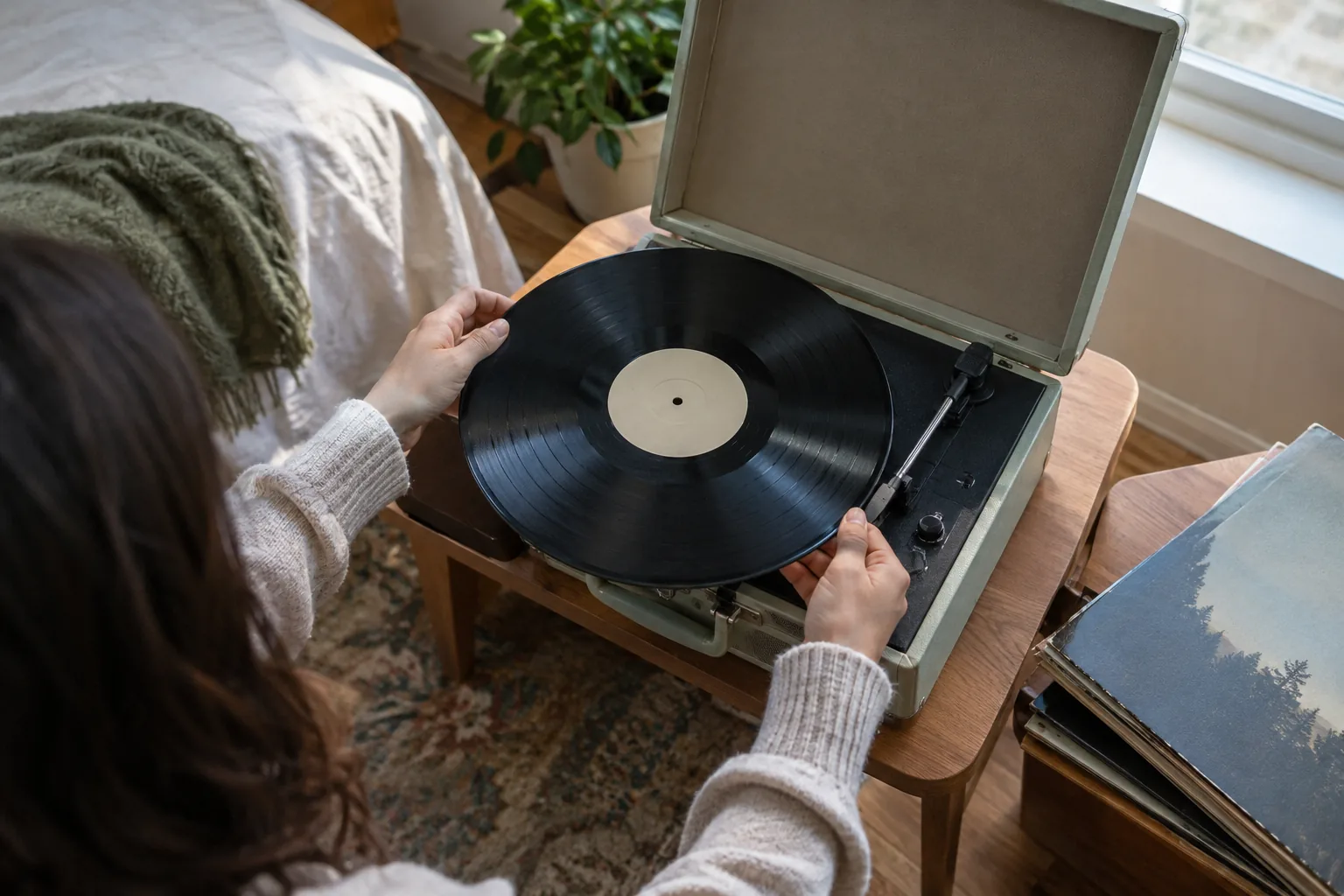
Are vinyl players with built-in speakers good?
They are good at what they are designed for: convenience. You unpack one, plug it in, and play a record with no separate speakers, cables or amplifier. That makes record players with built-in speakers a sensible entry point for a first collection, a gift, or a second player for a spare room.
The tradeoffs come from physics. Small speakers inside a case sit close together, so stereo separation is narrow. Bass depends on the size of the drivers and the enclosure, and a small woofer reaches less far into low frequencies than a larger driver in a bigger cabinet. For background listening and small rooms this is fine. For close listening, a pair of speakers placed apart gives the music more room.
That is why the outputs matter. A model with RCA outputs works today and still has a path forward.
All-in-one record player vs separate turntable and speakers
| Factor | All-in-one player | Separate turntable and speakers |
|---|---|---|
| Setup | Plug in and play | Several boxes and cables to connect |
| Stereo spread | Narrow, speakers share one case | Speakers set apart in the room |
| Upgrading | Only through its outputs | Swap the turntable, amplifier or speakers one at a time |
| Space | One footprint, easy to move | Needs a shelf or a stand for each piece |
| Phono stage | Handled inside the player | Built into the turntable or amplifier, or a separate phono preamp |
When you compare top record players with speakers, use this table rather than a ranked list. The right answer depends on your room and how closely you listen.
Bluetooth on all-in-one players
Bluetooth can mean two different things. Some players receive audio from your smartphone, so the built-in speakers also work as a small wireless speaker for digital music and streaming. Others send the record's audio to a wireless speaker or headphones. A listing that says only "Bluetooth" without naming the direction is worth skipping or asking about.
With record players with Bluetooth speakers, check which mode you get. The same applies to record players with speakers and Bluetooth in a suitcase case: the label alone does not tell you.
- Know the direction. On a player that receives Bluetooth, pairing carries your phone's audio to the built-in speakers. The record itself plays through the stylus and the speakers or outputs.
- Wired is simpler for records. If you connect external speakers, use the RCA outputs rather than a wireless link.
- Check the manual for pairing steps and which modes the player supports.
 In this guideVinylHaven$199.99View
What VinylHaven covers on the checklist
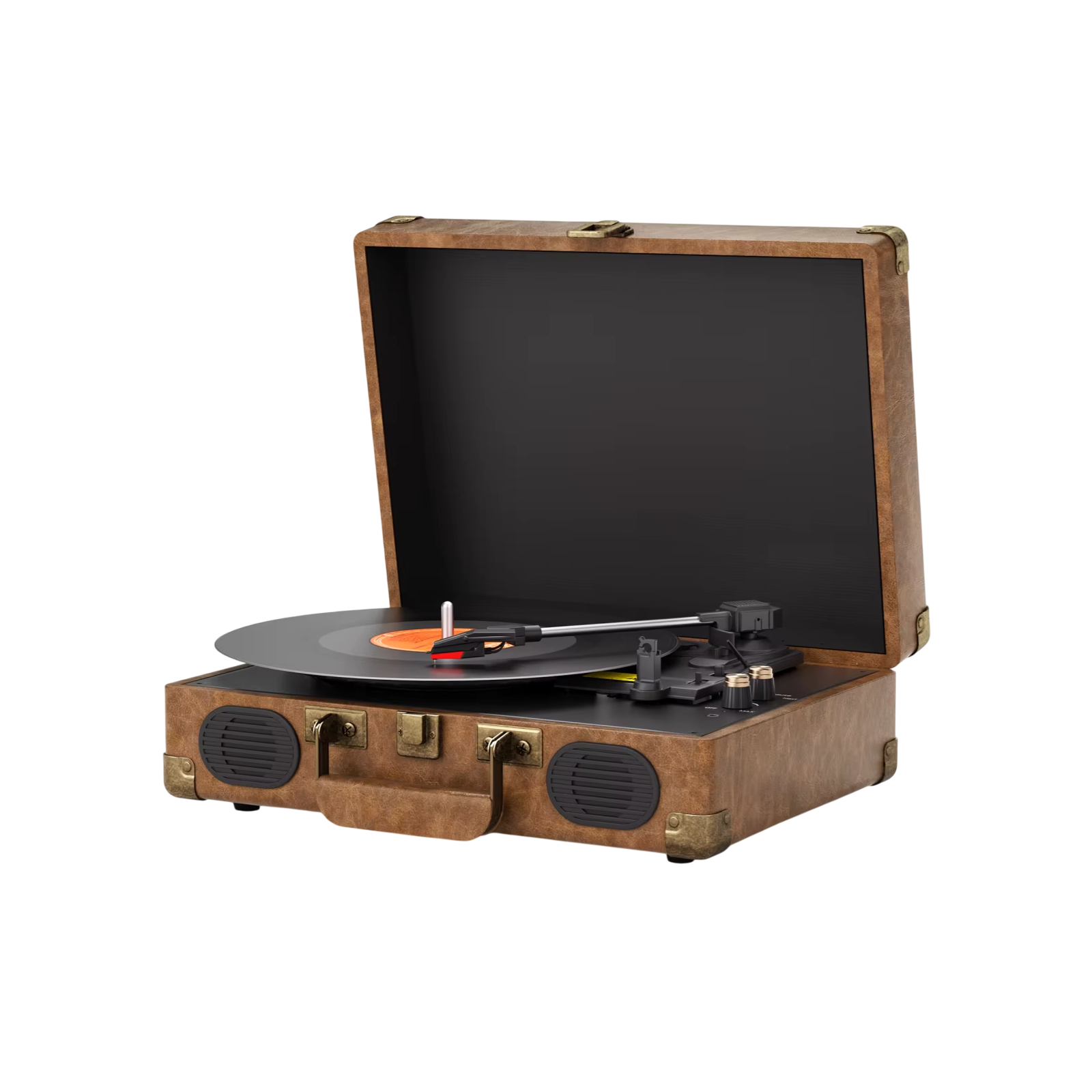
VinylHaven is a suitcase-style record player with built-in stereo speakers. Against the checklist above, the platter sits on a suspended plinth, separate from the speakers, and it uses a belt drive with an adjustable cartridge. It plays 33⅓, 45 and 78 RPM records, and an auto-stop function ends playback when a side finishes.
For connections it offers Bluetooth streaming from a smartphone, RCA outputs, a 3.5mm headphone jack and USB recording. The PU leather casing with bronze-tone hardware and a carry handle make it easy to move from room to room. The box includes the power adapter and a user manual.
How to set up a turntable
The setup is similar for most all-in-one players. Always follow your own manual for specifics.
- Choose a stable surface. Use a level table or shelf that does not wobble, away from the vibrations of any external speakers you add later.
- Unpack and plug in. Connect the power adapter and remove any transit clips or stylus guards described in the manual.
- Place the record on the platter with the side you want facing up.
- Select the speed. Match 33⅓, 45 or 78 RPM to the label or sleeve.
- Lower the tonearm. Use the lift lever and set the stylus onto the lead-in groove gently.
- Pick your listening mode. Use the built-in speakers, pair a smartphone, plug in headphones, or connect external equipment.
- Finish the side. When auto-stop halts the platter, lift the tonearm and flip the record.
Field note
Keep the volume moderate when you play records on a player with built-in speakers, and follow the manual on whether the lid can stay closed during playback. Strong speaker vibration reaching the stylus is one common source of muddy sound and skipping.
When to upgrade to external speakers
Built-in speakers are a starting point. Consider moving to external speakers when any of these happen:
- You move the player into a larger room and the sound feels thin.
- You want clearer left and right placement, which needs speakers set apart.
- You play records for long sessions and want more control over bass and treble.
- You want the same audio system to handle streaming, radio and USB files.
Do most record players need speakers?
Yes, in the sense that a turntable cannot make audible sound by itself. The stylus produces a very small signal that must be amplified and sent to speakers or headphones. Players with built-in speakers include that amplification. Separate turntables usually need either powered speakers or an amplifier with passive speakers.
Phono stage and preamp: what they do
A phono stage (also called a phono preamp) raises the stylus signal to a level an amplifier input can use and corrects it for playback. All-in-one players include this inside the case. A separate turntable may have a built-in phono stage, or it may need an amplifier with a phono input or a standalone phono preamp. Check the manual for the output type before you connect your turntable to anything.
Choosing between powered and passive speakers
| Setup | What you need | Good fit when |
|---|---|---|
| Powered (active) speakers | Speakers with their own amplifier, RCA cable from the turntable | You want the fewest boxes on the shelf |
| Passive speakers plus amplifier | An amplifier, speaker cable, RCA or AUX cable | You want to choose speakers and swap parts over time |
| Wireless speaker | A speaker that accepts a wired input or a supported wireless link | You want a simple one-speaker setup; see our portable Bluetooth speaker guide |
Bookshelf speakers are the usual choice for a desk or shelf. They fit beside a turntable, and placing them apart widens the stereo image compared with speakers inside the case. Floor-standing speakers suit larger rooms.
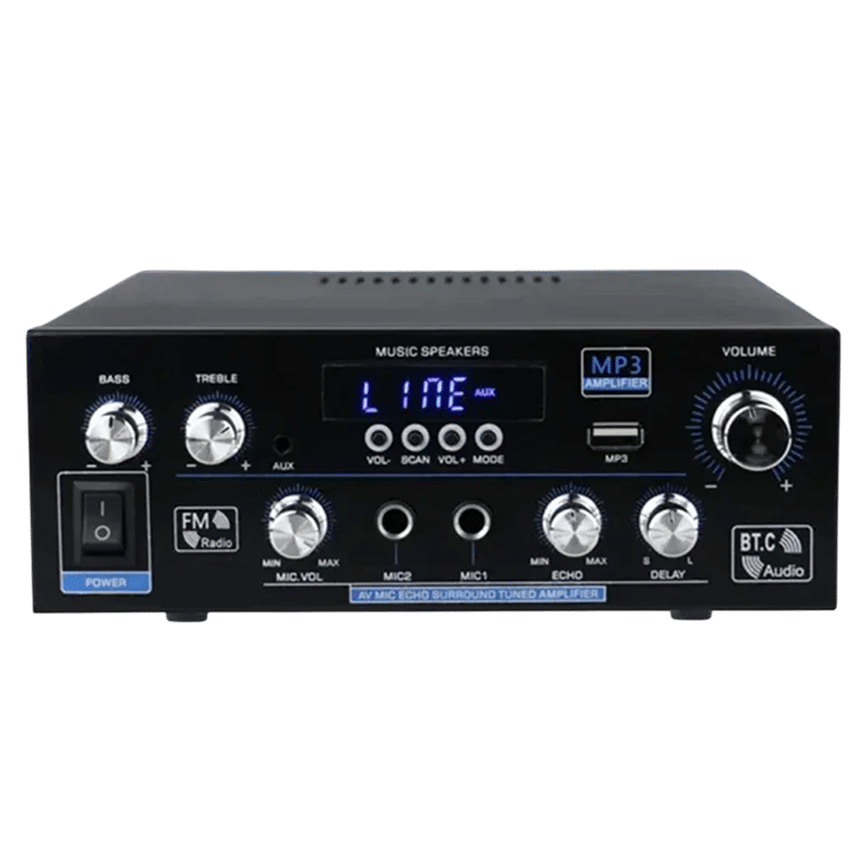
If you go the passive route, a stereo amplifier like StereoLux is one way to do it. It supports speakers from 4 to 16 ohms and provides 90W of peak power. It takes Bluetooth 5.0, USB, FM radio or AUX sources, and has bass and treble controls. If the player's manual confirms its RCA outputs are line level, connect them to the AUX input with a suitable cable, then adjust tone to suit your speakers and room.
 In this guideStereoLux$119.00View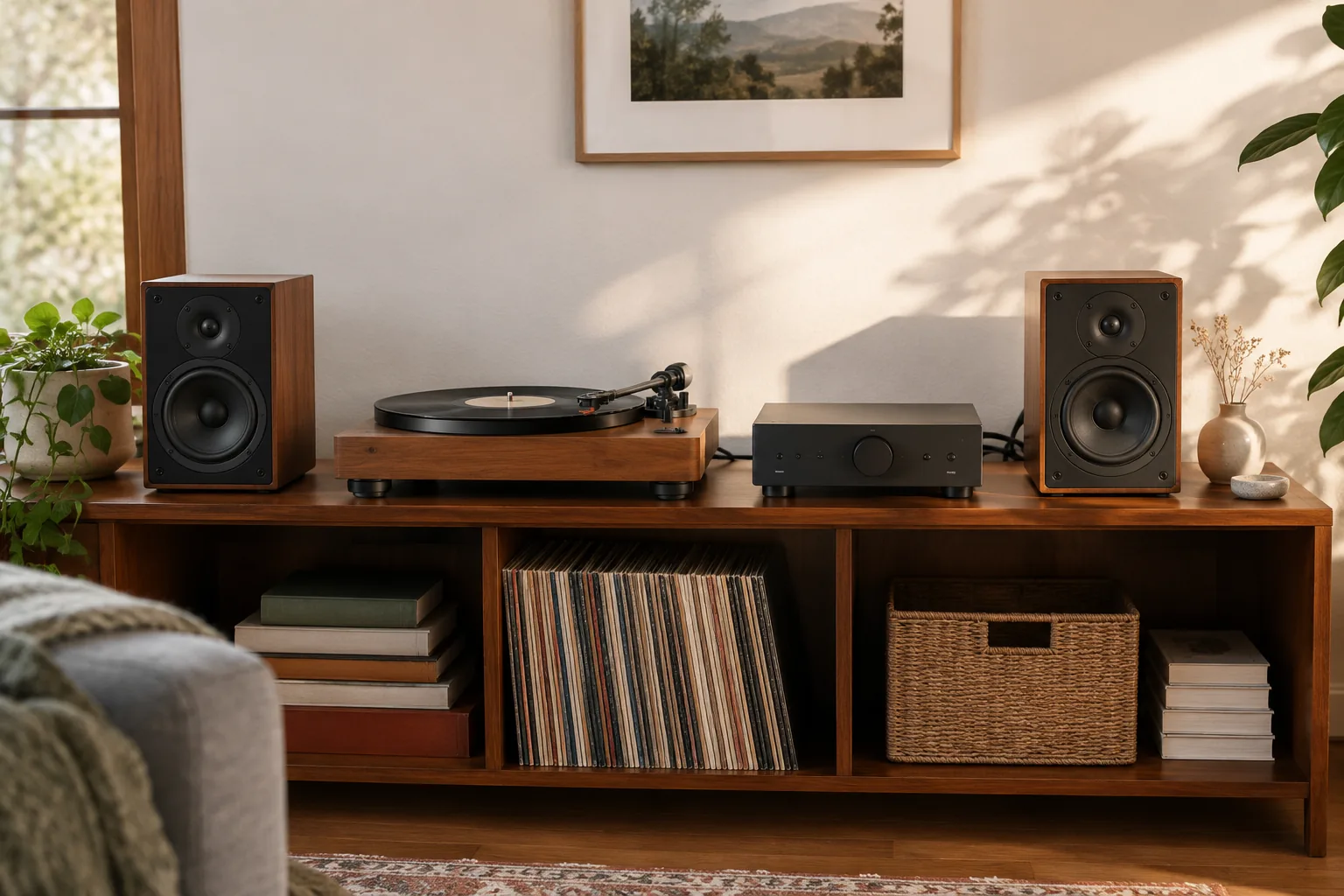
Browse the Speakers & Sound Systems collection for passive speakers and related gear. Before you buy, check that the speaker impedance matches what the amplifier supports.
Common mistakes and a simple care schedule
Mistakes to avoid
- Placing the player on a speaker or a surface that vibrates.
- Leaving records on the platter after listening.
- Pressing down on the platter or forcing the tonearm by hand.
- Mixing up speaker outputs and line outputs when connecting an amplifier.
- Connecting speakers below the impedance the amplifier supports.
Care routine
| When | Task |
|---|---|
| Before each side | Check the record for dust and lint; brush it with a carbon fiber brush if you have one |
| After each session | Lift the tonearm, return it to its rest, return the record to its sleeve, close the lid |
| Every few weeks | Wipe the case with a dry soft cloth; check the stylus for visible dust |
| When the sound changes | Check stylus wear and cartridge settings per the manual, or ask a qualified technician |
A stylus wears with use, so a change in sound, such as fuzzy or distorted playback, is a cue to look at it. Replace the stylus or cartridge only with parts the manual names for your player, and ask a qualified technician if you are unsure how to fit one.
Unplug the player before cleaning around the platter or cartridge, and follow the manual for any part you replace.
Quick decision steps
- Decide the room: a small room suits built-in speakers, a large room suggests external speakers.
- Confirm the adjustable cartridge, isolated platter and speed range.
- Confirm RCA outputs and a headphone jack.
- Read what Bluetooth does on that model.
- Start with built-in speakers, then add an amplifier and speakers when the room or the collection grows.
Following these steps keeps the listening experience simple now and open to changes later.
Frequently asked questions
Keep reading
 Speakers & Sound SystemsPortable Bluetooth Speaker Wireless Guide: How to Choose One9 min read
 Chargers, Docks & StorageLaptop Cooling Pad for Gaming: When It Helps and How to Set It Up7 min read
 Digital Photo Frames & DisplaysLarge Picture Frame Digital Guide: Size, Resolution and Placement8 min read